Every afternoon, hundreds of children run, jump, and fall in the various play areas of DéniaAnd they almost always land on the same material: rubber. What until recently was seen as the definitive solution to avoid scraped knees is now under scrutiny. Recent scientific research and the echoes of new European regulations have opened the debate on the safety of children's pavementsThis raises understandable concerns among families. What exactly lies beneath the feet of young children?
The Institute of Environmental Assessment and Water Research (IDAEA), part of the Spanish National Research Council (CSIC), has presented concrete data. Its studies confirm that the materials used in these recreational areas contain potentially toxic elementsThe main problem seems to arise when the soil begins to degrade due to sun exposure and daily use, at which point particles are released. However, researchers urge caution. While this exposure needs to be closely monitored, the findings to date are... They cannot confirm that going to the park causes direct harm. in the health of minors.
The rubber map in Dénia
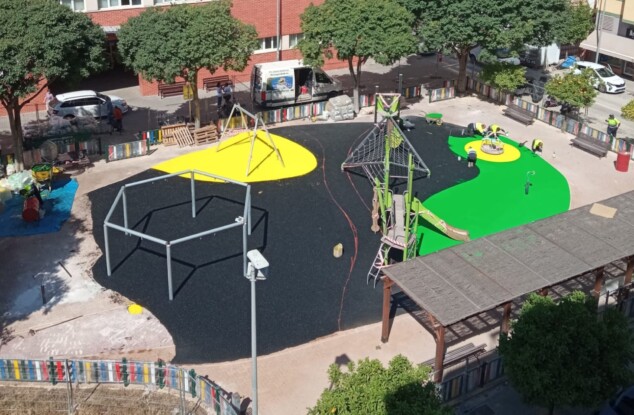
At street level, the City of Dénia It has made a firm commitment to this type of surface in its latest urban renovations. A simple stroll through the different neighborhoods is enough to confirm this. When one of the parks in the Jaume I squareThe council chose colored rubber flooring because the old tiles had lost their shock-absorbing capacity. history It was repeated at the popular water slide park of Chabàs Park, opened at the end of 2023, as well as in the newer early childhood space on the same site or in the play area next to the health center.
Nor is there a shortage of this material in high-traffic areas such as La Via street, Arxiduc Carles and Enric Valor squares, Cervantes esplanade, and so on. It is, for all intents and purposes, the most common surface in the municipality.
Additives, heat and the European confusion
For the past couple of years, scientists have been scrutinizing exactly what these tiles are made of. Studies published in journals such as "Science of the Total Environment" and "Journal of Hazardous Materials" have analyzed both the recycled tire-derived and the synthetic versions. They have detected everything from metals to microplastics and nanoplasticsIn addition to dozens of additives that react in particular ways when the pavement is exposed to the high temperatures of our summer. Harmful effects have even been observed in CABA agencies aquatic environments by simulating how rainwater carries these components. Despite the striking nature of the matter, the authors themselves insist that concentrations in a natural environment are lower and that this does not describe the exact chemical composition of the parks installed in the capital. the Marina Alta.
All this commotion has been fueled by a half-truthed rumor: the supposed ban on rubber parks by the European Union by 2031. The reality is quite different. Brussels has indeed set a deadline for marketing the loose granular fillerThe kind we see on artificial turf fields, in an attempt to curb the leakage of microplastics. However, the standard makes a huge distinction with the agglomerated pavements of the playgroundsWhere The particles are fixed to a solid matrixIn fact, the central government clarified a few months ago that the surface layer of these enclosures is usually sealed, thus avoiding the famous prohibition.